
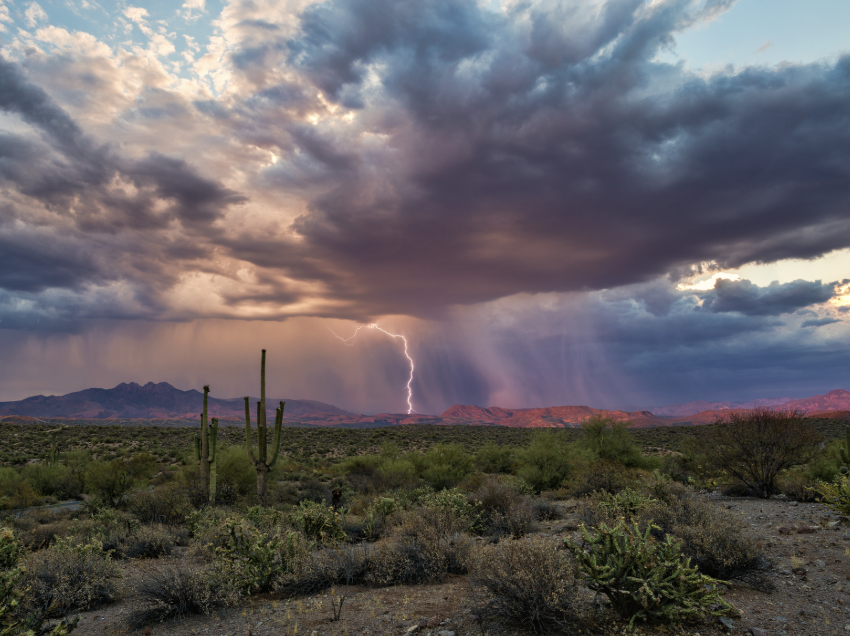
Each summer, Southern Arizona transforms from a dry desert to a humid environment that at times resembles Florida more than the desert. After months of relentless heat and dry desert brown, the North American Monsoon arrives — a dramatic annual shift in weather that brings thunderheads, sudden downpours, green rebirth, and a charged atmosphere unlike any other season.
The monsoon typically runs from early June through September, peaking in July and August. It’s driven by a seasonal shift in wind patterns and the buildup of heat over the U.S. Southwest and northern Mexico. Warm air draws moisture north from the Gulf of California and, to a lesser extent, the Gulf of Mexico and tropical Pacific. When that moisture collides with daytime heating and Arizona’s varied terrain – mountains, plateaus, and valleys – it spawns intense convection and thunderstorms.
Mornings are often clear and brutally hot, but by afternoon the sky fills with towering cumulonimbus clouds. Storms commonly develop over the highlands and drift down into valleys in the late afternoon or evening. Lightning forks across dramatic skies, thunder rolls for minutes, and sudden, heavy rain can turn dry washes into roaring torrents. The air smells fresher, humidity rises, and temperatures drop noticeably after a downpour.
Key features of the Southwestern monsoon season:
- Afternoon/evening thunderstorms: Short-lived but intense, producing heavy rain, frequent lightning, hail, and gusty winds.
- Haboobs (dust storms): Strong winds can push walls of dust ahead of storms, reducing visibility to near zero and creating eerie, orange skies.
- Flash flooding: Dry washes and urban streets can fill rapidly, posing serious hazards on roads and low-lying areas.
- Monsoon flora and fauna response: Creosote, ocotillo, palo verde, and many wildflowers green up; ephemeral pools and seasonal streams support insects, birds, and other wildlife.
- Cooling relief and humidity: While humidity increases, storms often bring welcome breaks from the relentless dry heat.
The monsoon is both highly anticipated and respected by residence in Southern Arizona. It brings needed water that replenishes soils, recharges groundwater, and triggers spectacular wildflower displays that paint the borders of roadways and mountains like a watercolor painting. At the same time, travel plans must account for sudden storms, roads may close from flooding, and outdoor workers adapt schedules to avoid late-afternoon lightning. Desert driving requires caution: never attempt to drive through flooded washes.
Safety tips
- Avoid dry washes during and after storms. They can flood quickly and with little warning.
- If you encounter a haboob while driving, pull over safely, turn off lights, and wait — don’t drive until visibility improves.
- Heed lightning safety: Move indoors; if that is not possible, sheltering in a vehicle is far safer than an isolated tree or open area.
- Carry water and extra supplies when hiking; summer trails can be deceptively dangerous between heat, humidity, and sudden storms.
Monsoon season also heavily influences local culture and cuisine, such as Summer festivals, lightning-themed art, and the comfort of hot-weather foods. Photographers cherish monsoon evenings for dramatic skies, shafted light, and lightning-lit horizons. Sunrise and sunset after storms are especially vivid, with saturated colors and clean, luminous air.
In short, Southern Arizona’s monsoon is a season of contrasts: intense heat giving way to violent storms, brown turning to green, and danger balanced by dramatic beauty. For those who respect its power and plan accordingly, the monsoon offers one of the most powerful and renewing natural spectacles in the Southwest.