
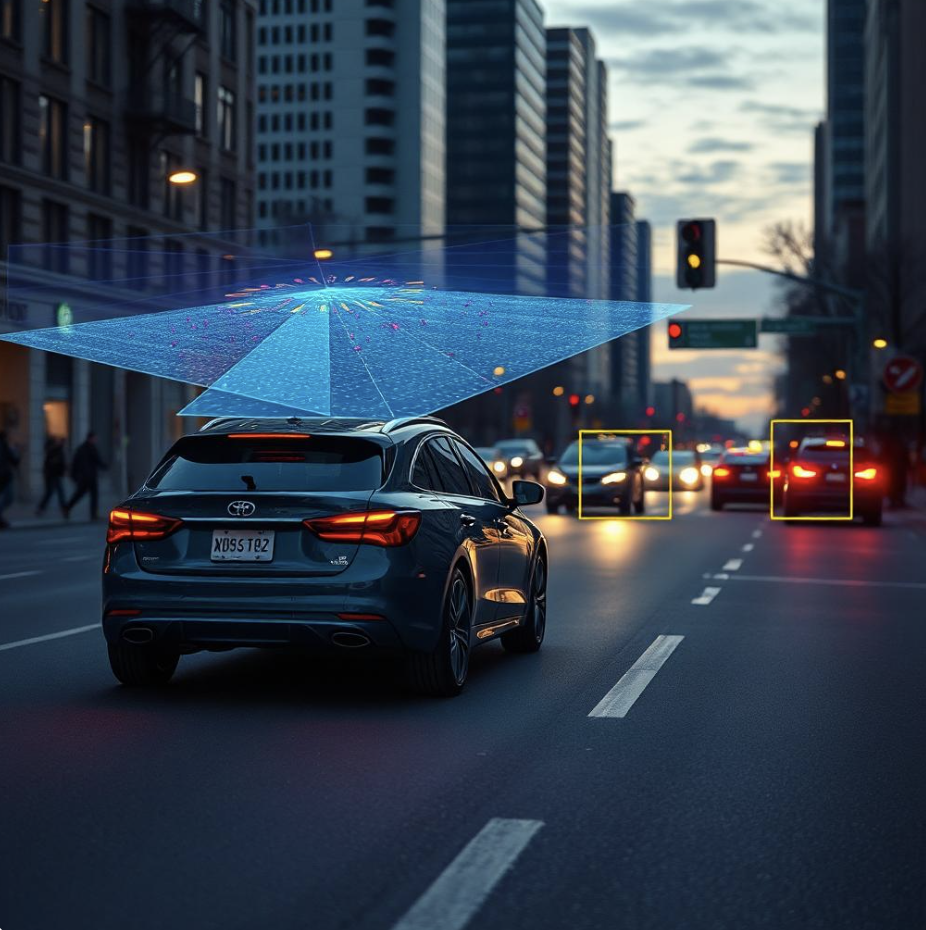
The next decade promises rapid evolution for Advanced Driver Assistance Systems (ADAS). As automakers, chipmakers, regulators and startups converge, ADAS will shift from isolated safety features to deeply integrated, cooperative systems that blend sensing, AI and connectivity with the aim of improving collision avoidance, occupant protection and traffic efficiency.
Several concrete programs and platforms scheduled for rollout or expansion will take shape in the immediate future. For example, Nvidia’s Drive Thor and subsequent software stacks aim to deliver centralized domain control and higher-capacity neural computations for more automated driving functions across more vehicle segments. Additionally, Qualcomm’s Snapdragon Ride and Snapdragon Cockpit platforms are being adopted by multiple OEMs to scale ADAS capabilities into mainstream models. Intel/Mobileye continues to push SuperVision (camera-first, surround ADAS) and Remote Assistance services; Mobileye’s roadmap toward scaled L2+/L3 features via resilient vision stacks is being pushed into several global launches. Also, Tesla’s Full Self-Driving (FSD) software (which remains controversial) continues iterative beta rollouts that influence public and regulatory expectations. Waymo, Cruise and other robotaxi efforts will also expand geofenced, highly mapped AD deployments, seeding perception and policy learnings for consumer vehicles.
Regulatory and safety program advances Regulators and testing bodies will accelerate ADAS standardization. Euro NCAP and IIHS are already updating protocols to reward driver monitoring, automated emergency steering and hands-off capabilities; expect mandatory driver monitoring systems (DMS) and clearer L2/L3 performance baselines in many markets. Public-private initiatives for cooperative V2X pilot corridors (e.g., smart highways, truck platooning lanes) will mature, providing infrastructure-side safety augmentation. Simply put, infrastructure is evolving alongside ADAS technology.
Expect three converging trends that will change in practice: sensor fusion at scale, stronger AI validation, and cooperative systems. Multi-modal fusion (camera + radar + high-resolution lidar in many vehicles) will reduce single-sensor failure modes. Formal verification, scenario-based testing and large-scale simulation will be institutionalized to validate edge-case behavior. And connectivity-driven cooperative perception (cloud and vehicle-to-everything, V2X) will let vehicles share tracked-object data and intent, expanding the “sight” beyond sensors’ line of sight.
Speculative technologies that may appear by 2036:
- Solid-state quantum-enhanced sensing: early research into quantum lidar or magnetometry could yield sensors with orders-of-magnitude range and noise performance improvements, enabling reliable detection in adverse weather.
- Distributed cooperative autonomy marketplaces: vehicles dynamically trade sensing and compute resources (edge-cloud marketplaces) to offload complex perception tasks during high-density traffic.
- Digital-twin city traffic fabrics: municipal-level digital twins continuously fused with live telematics and fleets could predict and preempt complex incidents, allowing vehicles to adopt risk-optimized trajectories in real time.
- Neuroadaptive driver interfaces: biometric-driven, adaptive ADAS that tune intervention aggressiveness to cognitive/physiological state (stress, fatigue) using non-invasive brain or nerve-signal proxies.
- Privacy-preserving federated ADAS learning: broader fleet learning without raw data sharing, accelerating rare-event learning while protecting user privacy.
Risks and open challenges Wider ADAS adoption raises issues: Like most improvements in automation, there is the risk of overreliance and skill degradation in drivers, cybersecurity risks in cooperative stacks, and liability frameworks for partially automated systems. Ensuring equitable deployment across vehicle price bands will be essential to prevent safety disparities.
Conclusion- By 2036, ADAS will be less a collection of independent features and more a coordinated safety nervous system — combining dense sensing, validated AI, and cooperative infrastructure. Known platforms from Nvidia, Qualcomm, Mobileye and the Robotaxi programs will drive near-term capabilities, while speculative advances like quantum sensing and digital twins could redefine what “preventable crash” means. The end goal: a measurable drop in accidents through smarter, more connected vehicles.